VedTimes.com | Political Desk
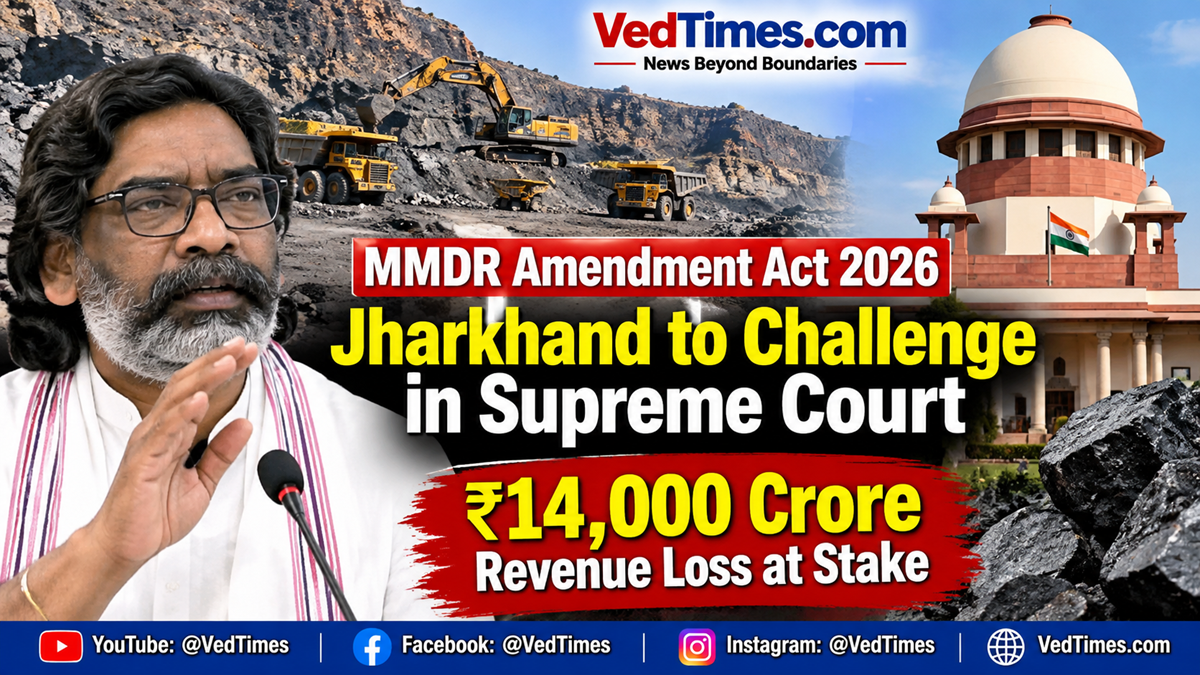
MMDR Amendment Act 2026: The Jharkhand government plans to challenge the Mines and Minerals (Development and Regulation) Amendment Act, 2026, in the Supreme Court.
The state believes the new law could restrict its powers to levy cess on mineral-bearing land.
The proposed legal challenge reflects growing concerns over the state’s financial autonomy.
Jharkhand depends heavily on its mineral resources for revenue.
The government fears that the amendment could significantly affect its finances.
Rupees 14,000 Crore Revenue Loss Feared
The Jharkhand government estimates that the amendment could cause a revenue loss of around Rupees14,000 crore in the financial year 2026-27.
Such a financial setback could create serious challenges for the state’s development programmes.
It could also affect several welfare schemes, including the Maiya Samman Yojana.
The state government considers mineral cess an important source of revenue.
It argues that any restriction on its powers could weaken its ability to fund public welfare and development projects.
State Plans Legal Battle in Supreme Court
Jharkhand plans to approach the Supreme Court against the provisions of the amended law.
The state intends to rely on the landmark 2024 Supreme Court judgment concerning the rights of states over mineral resources.
In that judgment, the Supreme Court recognised the states authority to tax mineral rights and mineral-bearing lands.
Jharkhand believes the new amendment could undermine the legal position established by the court.
The state wants the Supreme Court to examine whether Parliament’s latest amendment conflicts with the constitutional powers of state governments.
Centre Defends the Amendment
The Central government and supporters of the amendment defend the legislation as a nationwide reform.
They argue that the new framework will improve transparency in mineral trade.
It also aims to establish a uniform and stable tax structure across the country.
The Centre believes these changes will encourage investment and strengthen the mining sector.
It also maintains that states will retain their regular royalty income and other existing entitlements.
A Major Centre-State Financial Dispute
The dispute over the MMDR Amendment Act 2026 could have wider implications for Centre-state relations.
For Jharkhand, the issue goes beyond mineral taxation.
The state sees it as a question of financial independence and its ability to protect welfare spending.
The Supreme Court’s decision could shape the future relationship between mineral-rich states and the Centre.
It could also clarify the extent of state powers over mineral-related taxation.
As Jharkhand prepares its legal challenge, the financial stakes remain high.
The outcome could have a significant impact on the state’s revenue planning for 2026-27.
VedTimes.com | News Beyond Boundaries