VedTimes.com | International Desk
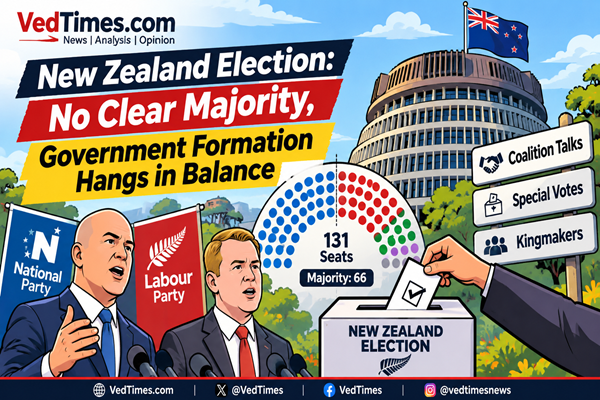
New Zealand Election 2026 Results: New Zealand faces political uncertainty after its general election produced an exceptionally close contest.
Neither major political party secured an outright majority.
The country could wait several weeks before learning who will lead its next government.
Preliminary results show Prime Minister Christopher Luxon’s National Party narrowly ahead in the race for government.
However, its existing coalition partners will play a decisive role.
The final outcome will depend on thousands of uncounted special votes.
National and Labour in a Neck-and-Neck Contest
The National Party secured 29.21 percent of the party vote.
The opposition Labour Party narrowly outperformed it with 29.36 percent.
Despite Labour’s marginal lead in the popular vote, National currently holds more parliamentary seats.
According to preliminary results, National won 42 seats.
Labour secured 36 seats, while the Green Party obtained 16.
National’s existing partners, ACT New Zealand and New Zealand First, secured 13 and 12 seats respectively.
Together, the three parties hold 67 seats in the 131-member Parliament.
They need 66 seats to command a parliamentary majority.
This gives Luxon’s coalition a narrow advantage.
However, the remaining votes could change the parliamentary arithmetic.
Special Votes Could Change Everything
Approximately 400,000 special votes remain uncounted.
These include overseas ballots and votes from people who voted outside their electorates.
Historically, special votes have tended to favour left-leaning parties.
This makes the final count particularly important for Labour and its potential partners.
The Electoral Commission expects to announce official results on November 27, 2026.
Until then, neither political bloc can confidently claim victory.
Smaller Parties Emerge as Potential Kingmakers
Smaller political parties could determine New Zealand’s next government.
The Opportunity Party has emerged as an important new player.
It secured approximately 5.96 percent of the party vote and 7 parliamentary seats.
Its entry into Parliament could reshape coalition negotiations.
Party leader Qiulae Wong has indicated an openness to working with either political side.
This gives her party considerable negotiating influence.
However, Luxon has previously ruled out a governing arrangement with Opportunity.
His party may need to reconsider its position if the final numbers change.
The Greens and Te Pāti Māori could also influence negotiations.
Their support could strengthen a potential Labour-led government.
Economic Concerns Shaped the Election
The cost of living dominated much of the election campaign.
Rising grocery prices, economic weakness and healthcare pressures influenced voter priorities.
National promised fiscal discipline and a return to budget surplus.
Labour focused on affordable healthcare and transport.
The results also reveal growing dissatisfaction with traditional political choices.
Both major parties received less than 30 percent of the popular vote.
This represents a significant setback for New Zealand’s two dominant political forces.
What Happens Next?
Luxon will continue as caretaker Prime Minister during the government formation process.
His administration will remain responsible for essential government functions.
Both National and Labour must wait for the official results before making decisive coalition moves.
The country could enter the Christmas period without a newly formed government.
Coalition negotiations may become complicated if the final numbers produce a different parliamentary balance.
VedTimes.com | News Beyond Boundaries