VedTimes.com | International Desk
Israel Political Crisis: Israel’s newly elected parliament has opened a new chapter in the country’s politics.
Former military chief Gadi Eisenkot now faces the challenge of forming a government and ending Benjamin Netanyahu’s long tenure as prime minister.
Israel is witnessing a major political showdown following its recent parliamentary elections.
The newly elected Knesset, Israel’s 120-member parliament, took oath on Tuesday.
Former Israeli military chief Gadi Eisenkot has received the responsibility of forming the next government.
President Isaac Herzog gave him the mandate on Sunday.
The election results have weakened Prime Minister Benjamin Netanyahu’s position.
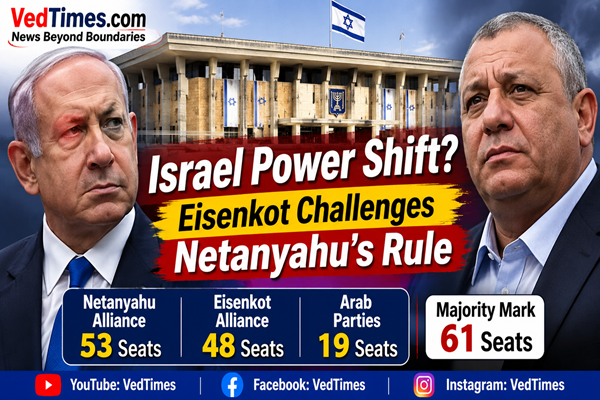
His political alliance secured 53 seats in the 120-member parliament.
Eisenkot’s alliance won 48 seats, while Arab-led parties secured 19 seats.
A government needs the support of at least 61 lawmakers to command a parliamentary majority.
Eisenkot Faces a Difficult Numbers Game
Eisenkot now faces a complicated political challenge.
His alliance falls 13 seats short of the majority mark.
The 19 Arab lawmakers could provide crucial support.
Together, Eisenkot’s allies and Arab parties could command 67 seats.
However, differences over cooperation with Arab parties complicate this possibility.
Several parties in Eisenkot’s alliance remain reluctant to depend on their support.
Eisenkot must also overcome disagreements among his own political partners.
His ability to bring different political groups together will determine his chances of forming a government.
Netanyahu Refuses to Give Up
Netanyahu’s Likud party remains the largest single party in the new parliament.
However, his broader political alliance lacks a parliamentary majority.
He currently continues as Israel’s caretaker prime minister.
His government will remain in office until a new coalition takes power.
Netanyahu has also called for a national unity government.
Such an arrangement could bring rival political camps together, but serious political differences stand in the way.
If Eisenkot fails, President Herzog could give Netanyahu another opportunity to form a government.
What Happens Next?
Eisenkot has 28 days to form a government.
The president can grant him an additional 14 days if necessary.
If both political camps fail to secure a majority, Israel could face another election.
The political contest also carries wider implications for Israel’s domestic and foreign policies.
Issues such as judicial reforms, military service, national security and the October 7, 2023 attacks remain central to the debate.
For now, Netanyahu faces one of the biggest political challenges of his career.
Eisenkot has the first opportunity to replace him, but securing the necessary parliamentary support remains a difficult task.
Israel’s political future now depends on coalition negotiations and the ability of rival parties to reach an agreement.
VedTimes.com | News Beyond Boundaries