VedTimes.com | News Desk
Jharkhand Foundation Day: Jharkhand completes 26 years as a separate state today.
Created on November 15, 2000, after its separation from Bihar, Jharkhand emerged from a long struggle for identity, autonomy and control over its natural resources.
The date also marks the birth anniversary of Bhagwan Birsa Munda, the legendary tribal freedom fighter.
His ideals of dignity, justice and rights over land continue to inspire the people of the state.
The demand for a separate Jharkhand carried enormous expectations.
People wanted better governance, local employment, quality education and improved healthcare.
They also wanted their mineral wealth to improve the lives of local communities.
Twenty-six years later, the question remains: How much of that dream has Jharkhand actually achieved?
Economic Growth: A Bigger Economy, but Unequal Benefits
Jharkhand has made progress in economic development. Its mineral resources have strengthened India’s coal, steel, power and manufacturing industries.
Cities such as Ranchi, Jamshedpur, Bokaro and Dhanbad remain important economic centres.
The state has also expanded its road network and industrial infrastructure.
According to the Jharkhand Economic Survey 2025-26, the state’s real Gross State Domestic Product increased from approximately Rs 1.51 lakh crore in 2011-12 to Rs 3.03 lakh crore in 2024-25.
However, economic growth has not benefited every household equally.
Many rural and tribal communities still struggle with poverty and limited economic opportunities.
The central challenge remains ensuring that the wealth beneath Jharkhand’s soil creates prosperity above it.
Employment: The Dream That Remains Incomplete
Employment was one of the biggest promises behind the separate state movement.
Jharkhand has educated a new generation of young people.
Its students now compete in national examinations, universities, sports and professional fields.
Yet, thousands of young people continue to search for government and private-sector jobs.
Many migrate to other states for better opportunities.
The Economic Survey 2025-26 highlights a complicated employment picture.
Overall youth unemployment has declined considerably, but urban graduate and diploma holders continue to face employment challenges.
The state needs more industries, modern skill-development centres and opportunities in tourism, agriculture and small businesses.
Creating jobs within Jharkhand must become a central development priority.
Education: Better Access, but Quality Remains a Concern
Education has witnessed considerable improvement over the past 26 years.
Literacy has increased, and more children now attend schools.
Girl’s participation in education has also improved.
The Economic Survey 2025-26 puts Jharkhand’s literacy rate at 76.70 per cent in 2023-24, compared with 53.56 per cent in 2001.
However, access to education does not automatically guarantee quality learning.
Teacher shortages, inadequate infrastructure and poor educational facilities continue to affect several rural and tribal areas.
Students from economically weaker families often struggle to access quality higher education.
The state must strengthen government schools and improve access to technical and professional education.
Healthcare: Progress, but Rural Areas Need More Attention
Jharkhand has improved several healthcare indicators. Institutional deliveries have increased, and maternal and infant mortality rates have declined.
According to the Economic Survey, the maternal mortality ratio fell to 54 per 100,000 live births in the 2021-23 period.
Despite this progress, healthcare remains a major concern in remote districts.
Many villages lack adequate medical facilities, specialist doctors and emergency healthcare services.
Malnutrition and anaemia also remain serious public health challenges.
The government must strengthen primary healthcare and ensure that quality treatment reaches the last village.
Roads and Infrastructure: A Visible Transformation
Infrastructure development represents one of the more visible achievements of the state.
Road connectivity has improved across several districts.
Urban centres have witnessed changes in transportation, housing and public facilities.
The state’s road network increased from 12,936 kilometres in 2021 to approximately 15,047 kilometres in 2025, according to the Economic Survey.
However, many remote villages still face problems with drinking water, electricity, transportation and internet connectivity.
Development must reach beyond major cities and industrial centres.
Tribal Identity and Culture: The Original Promise
Jharkhand’s creation was not merely an administrative decision.
It represented a movement to protect tribal identity, culture, traditions and rights over natural resources.
The state has made efforts to recognise its diverse cultural heritage.
Festivals such as Sarhul, Karma, Sohrai and Tusu remain central to its social identity.
Languages such as Santali, Mundari, Ho, Kurukh, Nagpuri, Khortha and Kurmali represent its rich linguistic diversity.
However, questions surrounding land rights, displacement, forest rights and the protection of tribal communities remain important.
Mining and industrial projects have also raised concerns about environmental damage and the displacement of local populations.
The real test lies in balancing economic development with environmental protection and community rights.
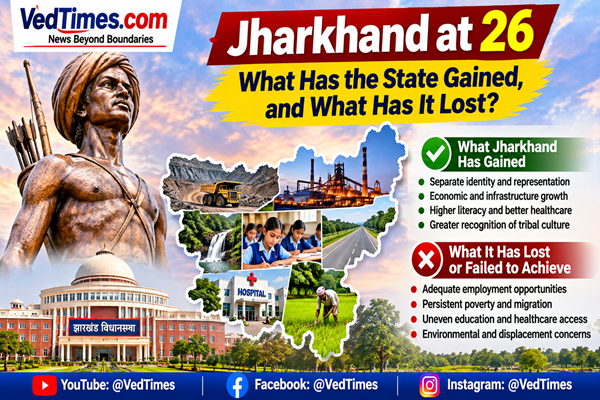
What Has Jharkhand Gained in 26 Years?
The state has achieved several important milestones:
- A separate political and administrative identity.
- Expansion of roads and industrial infrastructure.
- Growth in the economy and urban development.
- Improvement in literacy and school participation.
- Better maternal and institutional healthcare indicators.
- Greater recognition of tribal identity and cultural heritage.
- Opportunities for local leadership and regional representation.
What Has Jharkhand Lost or Failed to Achieve?
The other side of the journey reveals several unfinished promises:
- Employment opportunities remain inadequate for many educated young people.
- Poverty and economic inequality continue to affect vulnerable communities.
- Migration remains a livelihood strategy for many families.
- Quality education and healthcare remain unevenly accessible.
- Mining has created environmental and displacement concerns.
- The benefits of mineral wealth have not reached all local communities.
- Drinking water and basic infrastructure remain inadequate in several rural areas.
The Road Ahead: What Should Jharkhand Prioritise?
As Jharkhand enters its 27th year, the government must move beyond announcements and focus on measurable results.
First, it must create employment through industrial diversification and support for local businesses.
Second, it must improve government schools, colleges and healthcare facilities.
Third, it must strengthen agriculture and rural livelihoods.
Farmers, women and small entrepreneurs need better access to markets and technology.
Fourth, it must protect forests, rivers and tribal land rights.
Development should not come at the cost of the environment or indigenous communities.
Finally, the government must improve transparency and accountability in public administration.
Conclusion: 26 Years Later, the Dream is Still Alive
Jharkhand has travelled a long distance since November 15, 2000.
It has established its identity and made progress in several areas.
But its natural wealth still presents a striking contrast with the economic struggles of many residents.
The state was created with the dream of a better future for its people.
That dream cannot become reality through mineral production, highways and industrial investments alone.
It requires jobs for young people, quality education for children, affordable healthcare, secure livelihoods and dignity for tribal communities.
Twenty-six years later, Jharkhand has reasons to celebrate.
It also has important questions to answer.
VedTimes.com | News Beyond Boundaries